




















‘LEARNING BY DOING’ APPROACH IS KEY TO DRIVING INNOVATION, SAYS LEADING AGRICULTURAL RESEARCHER
From regenerative systems and precision inputs, to robotics, AI and circular energy use, rigorous research and real-world conditions can help produce better food while farming in harmony with the environment through a focus on ‘learning by doing’ – that was the message from the keynote speaker at the latest Lovewell Blake/NFU Farmers’ Evening held at Halesworth Golf Club.
Around 60 farmers from Norfolk and Suffolk came together to hear Richard Meredith, head of research at Dyson Farming, explain how his organisation integrates experimentation, data, engineering and practical farming to test ideas, challenge assumptions and deliver evidence‑led improvements in food production, sustainability and efficiency.
Outlining the philosophy of Sir James Dyson, who founded the Lincolnshire-based agriculture giant, Mr Meredith said, “Throughout his career, he has relied on factual analysis and evidence‑based decision‑making. He avoids approaches driven by hunches, uncertainty, or untested assumptions.
“We understand that agriculture is shaped by many people and long‑standing practice. Sir James’s previous work in engineering and technology showed how innovation can drive progress, and he applies that mindset in farming by focusing on practical improvements and open knowledge‑sharing.”
Mr Meredith suggested that engineers who didn’t have any preconceptions about farming brought a different way of thinking into agriculture. “In agriculture, some long‑standing challenges are often viewed as difficult to solve. Engineers, approaching these issues without prior assumptions about crop production, have introduced new perspectives that have helped re‑evaluate what might be possible.
A particular focus within Dyson Farming is accelerating the process by which research translates to widespread practice. “Research can be slow - this is one of my issues with it. It's really hard to get things from conception to on-farm practice. One of the things we want to do with the Dyson Farming Research Centre is to accelerate research; when there's a good idea, when there's something coming through, we want to make sure that we find a way to make it get to the end user fast.”
Mr Meredith emphasised the importance of data in driving progress, and in particular the quality of data in maximising the usefulness of artificial intelligence. “AI is advancing rapidly, and the aim is to understand the opportunities it offers, particularly its ability to reveal insights within existing datasets.
“AI is not a substitute for business management or strategic decision‑making. It requires accurate, well‑structured information as input, and its performance is directly tied to the quality of that data.”
Lovewell Blake agricultural partner Ryan Lincoln, who chaired the event, said, “The work being carried out by Dyson Farming is having an increasing impact on agriculture right across the UK. It was fascinating to hear about the ‘learning by doing’ approach the firm takes, something which we can all adopt at a farm level.”
The Lovewell Blake/NFU Farmers’ Evenings take place across the year at Halesworth Golf club. The next event will be in November, with details announced in due course at www.lovewell-blake.co.uk/events.
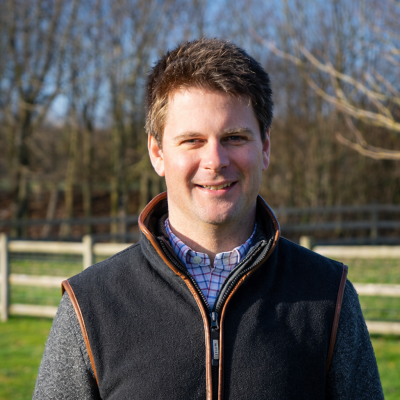
Richard Meredith
Mr Meredith is head of research at Dyson Farming, where he leads the company’s research and innovation programme across its farming operations. He is responsible for shaping research strategy, translating on‑farm challenges into practical trials, and ensuring research activity delivers clear, commercial value for the business.
He manages Dyson Farming’s 1,000‑acre dedicated research farm, the Dyson Farming Research Centre, which serves as a real‑world testbed for trialling new technologies, agronomic approaches, and farming systems at scale. His work focuses on applied research that can be rigorously tested, refined, and confidently implemented within commercial farming operations.